
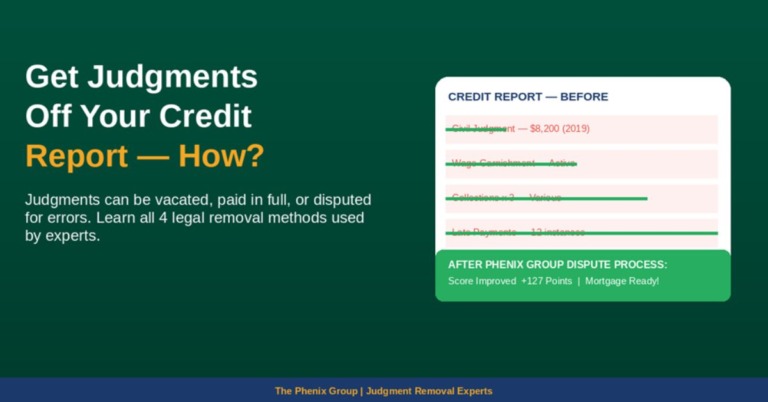
If you’re searching for how to remove a judgment from your credit report, you’re probably expecting a complicated legal process or some hidden trick. The reality is a bit different, and in many cases, much simpler than people think.
Here’s the key fact most websites still fail to explain clearly:
Judgments are no longer included on credit reports in most situations.
This major change completely shifted how judgments affect your credit. However, confusion still exists because judgments can continue to appear in public records and sometimes show up through third-party data sources. That’s why understanding what’s really happening, and what actions actually work, is essential. At The Phenix Group, our credit specialists help clients navigate exactly these kinds of complex credit situations every day
Are Judgments Still on Credit Reports?
Since 2017, the three major credit bureaus removed civil judgments from consumer credit reports. This decision came after widespread issues with inaccurate data and stricter requirements for verifying public records.
In practical terms, this means most people will not see a judgment listed on their credit report anymore. If you’ve recently checked your report and didn’t find one, that’s completely normal.
However, this does not mean judgments have disappeared entirely. Lenders, landlords, and financial institutions may still access them through public record databases. So while your credit score may not be directly impacted, the judgment can still influence financial decisions behind the scenes.
What Is a Judgment and Why Does It Matter?
A judgment is a court order confirming that you owe money to a creditor. It usually happens after a lawsuit, often when a debt goes unpaid and the creditor takes legal action.
Even though judgments are no longer part of standard credit reports, they still matter because they exist in legal records. These records can be reviewed during loan approvals, background checks, or financial screenings. That’s why removing or resolving a judgment is still important for your overall financial profile, especially if homeownership is one of your goals. Our home ownership credit repair program is specifically designed to help buyers clear these kinds of obstacles before applying for a mortgage.
Why Judgments Were Removed from Credit Reports
The removal wasn’t random. Credit bureaus were facing increasing pressure due to inaccurate reporting of public records. Many judgments were being linked to the wrong individuals or lacked complete identifying information.
To comply with stricter standards, the bureaus decided to eliminate most public record data, including civil judgments. This improved overall accuracy but also created confusion, especially since older advice about “removing judgments” is still circulating online.
How to Remove a Judgment from Your Credit Report
If a judgment is still showing on your credit report, which is rare but possible, there are clear steps you should take.
The first step is to review your credit report carefully. Look for any mention of public records or legal entries. If you don’t see the judgment listed, there is nothing to remove from your report, and your focus should shift to public record handling instead.
If it does appear, verify every detail. Check your name, the court information, the amount, and the dates. Even a small inconsistency can be enough to challenge the entry.
Once you’ve confirmed there is an issue, file a dispute with the credit bureau reporting it. Our sample dispute letter guide walks you through exactly what to include and how to document your case. Credit bureaus are required to investigate and respond, usually within 30 days.
If the judgment is accurate, removing it becomes more complex. At this point, the focus shifts from credit bureaus to the court system.
What If the Judgment Is Accurate?
When a judgment is valid, the most effective path is to address it legally rather than trying to dispute it blindly.
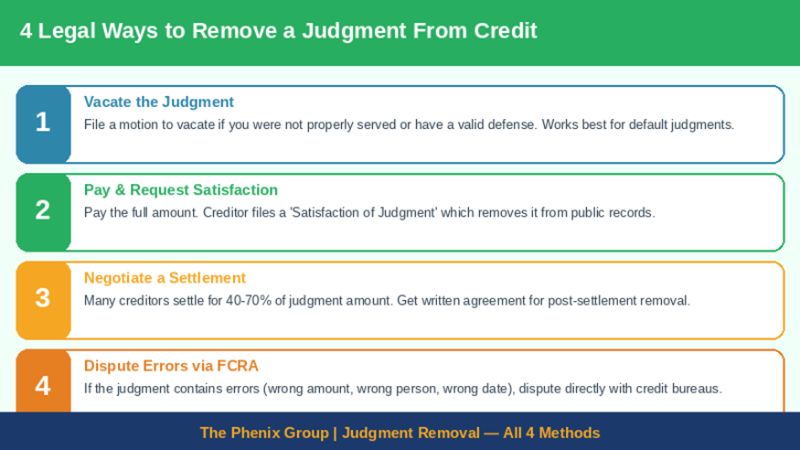
One option is to request that the court vacate the judgment. This essentially cancels the ruling and can remove it from public records. This process may involve proving improper service, errors in the case, or reaching an agreement with the creditor.
Another approach is resolving the debt and ensuring the judgment is marked as satisfied. While this doesn’t erase the record, it shows that the obligation has been fulfilled, which can improve how lenders view your situation. You can see real examples of how clients have resolved these kinds of issues by reviewing our results page.
Can You Remove a Paid Judgment?
Paying a judgment does not automatically remove it. This is one of the most common misconceptions.
Even after payment, the record may remain unless further action is taken. In some cases, you can request the court to update the record or pursue a motion to vacate. Success depends on local laws and the specifics of the case.
Although a paid judgment is better than an unpaid one, it’s still worth exploring removal options if you want a cleaner financial profile. If you’re unsure whether professional support is worth it at this stage, our article on why DIY credit repair often falls short can help you weigh the risks of going it alone.
How Long Do Judgments Stay on Record?
While they are no longer part of credit reports, judgments can remain in public records for several years. The exact duration depends on jurisdiction, but it often extends beyond seven years and may be renewable.
This is why simply waiting for a judgment to disappear is not always the best strategy. Taking action early can save you from complications later, especially when applying for loans or housing.
How to Remove a Judgment from Public Records
Removing a judgment from public records requires a more hands-on approach. Unlike credit report disputes, this process involves the legal system directly.
You may need to file a motion with the court, negotiate with the creditor, or demonstrate that the judgment was entered incorrectly. Each situation is different, so the process can vary in complexity.
For many people, this is where professional help becomes valuable. Our team in Fort Worth and Dallas has extensive experience guiding clients through exactly these kinds of legal and credit-related challenges. Legal guidance or credit repair expertise can simplify the process and increase your chances of success.
Common Mistakes That Delay Removal
One of the biggest mistakes people make is relying on outdated information. Many guides still suggest methods that no longer apply after the 2017 changes.
Another issue is assuming that paying a judgment solves everything. While it’s an important step, it does not remove the record by itself.
Ignoring the judgment entirely is also risky. Even if it’s not on your credit report, it can still affect financial opportunities in ways that are not immediately visible. If you’re wondering whether working with a credit repair company could actually harm your situation, read our honest breakdown: can a credit repair company hurt your credit?
Frequently Asked Questions
Can I remove a judgment myself?
Yes, in many cases you can handle disputes or court filings on your own. However, legal processes can become complex depending on the situation.
Do judgments still affect credit scores?
Not directly anymore, since they are no longer included in credit reports. However, lenders may still consider them through other sources.
Why did my judgment disappear from my credit report?
This is due to the policy change where credit bureaus removed most public records to improve accuracy.
Can a judgment come back on my credit report?
It’s unlikely, but if new verified data is reported, it could reappear under certain conditions.
Should I hire a credit repair company?
If the situation involves legal complications or multiple issues, professional assistance can make the process smoother and faster.
You can learn more about how our process works and what it costs before committing to anything.
Final Thoughts
Trying to remove a judgment from your credit report can feel overwhelming, especially with so much outdated advice online. The truth is that the landscape has already changed, and in many cases, the problem may not be your credit report anymore, but the public record behind it.
Understanding this difference is what allows you to take the right steps instead of wasting time on ineffective solutions. Whether you’re disputing an error, resolving a valid judgment, or exploring legal options, the key is to act with accurate, up-to-date information.
If you approach the process strategically, removing or minimizing the impact of a judgment becomes far more achievable than it first appears.
