
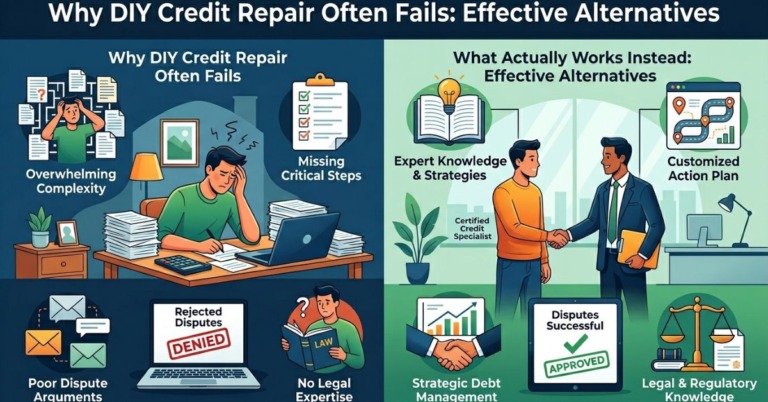
You pulled your credit reports. You spotted the errors. You sent the dispute letters, and then waited. Thirty days later, the bureau came back with a one-word verdict: Verified. Nothing changed. Sound familiar?
You are not alone, and more importantly, you did not fail because you lacked effort. DIY credit repair fails most of the time because the credit reporting system is built for a level of legal knowledge and procedural precision that most consumers simply have not been trained for. According to the Consumer Financial Protection Bureau (CFPB), credit reporting complaints rose from roughly 542,000 in 2020 to nearly 5 million by 2025, most of them from people who tried to fix errors and hit a wall.
This guide breaks down the seven core reasons DIY credit repair falls short, shows you the real financial cost of letting it drag on, and explains the specific situations where professional help, particularly attorney-backed credit repair, becomes not just helpful but necessary.
What DIY Credit Repair Really Involves (It’s Not Just Sending Letters)
At face value, DIY credit repair looks straightforward: get your credit reports from Equifax, Experian, and TransUnion, identify anything inaccurate or outdated, and file a dispute. Simple enough, right?
In practice, the process requires you to understand the Fair Credit Reporting Act (FCRA), know which specific sections govern furnisher obligations (Section 623) versus bureau responsibilities (Section 611), monitor three separate credit files that update independently and on different timelines, draft dispute letters that contain legally precise language rather than generic templates, and follow up on each dispute across each bureau within strict timeframes. Miss one step, even a minor one, and months of work can be wiped out.
To understand how the professional process compares, see our guide on how credit repair companies work.
The 7 Core Reasons DIY Credit Repair Fails
1. Generic Dispute Letters Get Rejected or Ignored
Credit bureaus in 2025 use automated screening systems that flag vague or templated dispute submissions. If your letter does not clearly identify the specific account, the specific error, the applicable FCRA provision, and the supporting documentation, it gets flagged as ‘frivolous’ under Section 611(a)(3) and dismissed without investigation.
A generic letter downloaded from a website carries none of that specificity. Professional dispute writers understand the exact language that triggers a thorough investigation versus the kind that gets auto-dismissed. This is one area where a properly crafted credit dispute letter by an experienced professional makes a measurable difference.
2. You’re Not Tracking All Three Bureaus Consistently
Equifax, Experian, and TransUnion each maintain a separate file on you. A dispute filed with one bureau does not automatically flow to the others. This means an error that is removed from Experian may still be dragging your score down on TransUnion, and you may not realize it for weeks or months.
DIY credit repair almost universally fails at this cross-bureau tracking challenge. Professionals manage all three files simultaneously, comparing bureau responses and adjusting strategy as results come in.
3. Missing Response Deadlines Kills Your Progress
Under the FCRA, bureaus have 30 days to investigate a dispute. But when they respond, whether with a request for more documentation, a verification notice, or a result, you must act promptly. Missing a verification window or failing to respond to a bureau’s request can reset your timeline or close the dispute entirely. Life gets in the way. Work deadlines, family obligations, and the sheer number of items on a complex credit file make consistent follow-up one of the biggest practical failure points in DIY repair.
4. Disputing Accurate Information Backfires
Many consumers, frustrated by low scores, begin disputing everything on their report, including accounts that are accurate. This is a costly mistake. Successfully having an accurate item temporarily removed simply delays the clock; the furnisher can legally re-insert the item once verified. Worse, repeated disputes without new evidence or legal basis damage your credibility with both bureaus and furnishers, making future legitimate disputes harder to win.
5. You Don’t Know FCRA Section 623, Furnishers Do
Most people are aware their disputes go to credit bureaus. Fewer know that under FCRA Section 623, disputes can be sent directly to the furnisher (the creditor or collection agency reporting the item). Furnisher-direct disputes carry different procedural requirements, and when a furnisher violates them, you have potential grounds for legal action. This is exactly the kind of leverage that an attorney-backed credit repair process can use on your behalf and that a pure DIY approach will miss entirely.
6. Complex Cases Need Legal Leverage
Identity theft, multiple charge-offs, bankruptcies, re-aged collection accounts, these are not situations that a template dispute letter was designed to handle. Complex credit files require a coordinated strategy that covers multiple accounts, references specific legal provisions, and in some cases escalates to direct legal action. Without that framework, you are essentially bringing a form letter to a compliance battle.
It is worth understanding whether professional credit repair services actually work before making a decision, the research is reassuring.
7. Time and Consistency Are Make-or-Break
A single dispute round is rarely enough. Credit repair for anything beyond a minor isolated error typically involves multiple rounds of disputes, responses, follow-ups, and adjustments over several months. That level of sustained attention is difficult to maintain alongside a full-time job and family life. It is the number-one reason DIY efforts stall at the six-week mark, not because consumers give up, but because real life intervenes and the process loses momentum.
The Real Financial Cost of Failed DIY Credit Repair
People often assume the worst case scenario of failed DIY is simply ‘no progress.’ The actual cost is far higher and more concrete. Consider: a credit score difference of just 40 points can be the difference between a 6.5% and a 7.4% mortgage interest rate on a $300,000 home loan. Over 30 years, that difference adds up to more than $60,000 in additional interest paid.
Add to that the opportunity costs: delayed home purchase, a rental application that gets rejected, a car loan approved at a punishing rate, or a job offer rescinded because of a background credit check. Every month that DIY repair stalls is a month those outcomes stay out of reach.
Understanding credit repair pricing becomes much clearer when you set it against the financial cost of doing nothing, or doing it wrong.
DIY vs. Professional Credit Repair: An Honest Comparison
| Factor | DIY Credit Repair | Professional (Attorney-Backed) |
| Cost | Free (but time-costly) | Monthly fee, no setup charge |
| Dispute quality | Template-based, often generic | Legally precise, FCRA-cited |
| Bureau tracking | Manual, easy to miss | Systematic across all 3 bureaus |
| Legal leverage | None | FCRA violations actionable |
| Complex case handling | Poor, no strategy framework | Designed for complex files |
| Time required from you | 10-15 hrs/month ongoing | Minimal, team handles it |
| Re-insertion protection | Rarely caught in time | Monitored continuously |
| Success rate | Variable, often stalls | Higher, compliance-driven |
When DIY Is Fine And When You Need Professional Help
DIY may be appropriate when:
- You have one or two isolated, clearly documented errors (wrong address, duplicate account)
- You have the time and patience to follow up weekly over 3–6 months
- Your credit issues are straightforward, no charge-offs, collections, or identity theft
- You are not under a homebuying, refinancing, or loan approval deadline
Professional help is the smarter path when:
- You have multiple negative accounts across different creditors
- Previous DIY disputes have come back ‘verified’ without explanation
- You are preparing to buy a home or refinance within 6–12 months
- You have experienced identity theft or fraud on your reports
- You have tried DIY for 60+ days and seen no meaningful movement
- Your situation involves bankruptcies, charge-offs, or collections from original creditors
To understand the full scope of what professional credit repair includes, read our breakdown of credit repair packages and how to identify quality providers.
It is also worth understanding the difference between credit repair and credit restoration these terms are often used interchangeably but carry distinct meanings.
How The Phenix Group’s Attorney-Backed Process Is Different
The Phenix Group is not a standard credit repair mill. Our process is built around attorney engagement, which means every dispute strategy is developed with FCRA and CROA compliance at its core, not just filled-in templates, but legally defensible dispute positions that furnishers and bureaus take seriously.
With over 80 years of combined experience on our team, we have seen virtually every credit profile scenario. Clients preparing to buy a home work alongside our specialists and their lender, on a timeline that is built around the closing date, not around the bureau’s convenience. Clients dealing with identity theft get a coordinated legal strategy, not a single dispute letter.
We begin with a free credit analysis, no contracts, no commitments upfront. We review your full credit file, identify every inaccuracy and compliance issue, and then walk you through exactly what we can do before you decide whether to proceed. Our pricing is based on what your file actually needs, not a flat subscription that charges you for nothing.
Whether you are in Fort Worth, Dallas, or anywhere across the country, our credit specialists are available for a free consultation to review your situation and give you an honest assessment.
Frequently Asked Questions About DIY Credit Repair
Can DIY credit repair actually hurt my credit score?
Generally, a failed DIY dispute will not lower your score directly. However, disputing accurate accounts can trigger investigations that lead to re-verification and stricter scrutiny on future disputes. Repeated, unsupported disputes can also reduce your credibility with furnishers. The real damage is indirect: time lost, stalled progress, and missed financial opportunities during the period repair is not working.
How long does DIY credit repair typically take?
Each dispute round takes 30 days under the FCRA. For simple, isolated errors, one round may suffice. For complex files with multiple issues, DIY credit repair can take 6 to 18 months, often with stalls and setbacks. Professional credit repair with a structured strategy typically produces meaningful results in 3–6 months for most clients. See our breakdown of credit repair facts for realistic timelines.
Why does the credit bureau keep saying my dispute is ‘verified’?
‘Verified’ means the furnisher confirmed the information when the bureau contacted them. This does not always mean the information is accurate, it means the furnisher responded within the 30-day window. If you believe the item is still inaccurate, the next step is to dispute directly with the furnisher under FCRA Section 623, request validation of the debt, and if violations occurred, consider legal escalation.
Is it illegal for a credit repair company to charge upfront fees?
Yes. Under the Credit Repair Organizations Act (CROA), credit repair companies cannot collect payment before services are delivered. Any company requesting a large upfront payment before doing any work is operating illegally. The Phenix Group follows a monthly processing fee structure, you only pay as work is actively performed.
What is attorney-backed credit repair and why does it matter?
Attorney-backed credit repair means a licensed attorney is involved in the dispute strategy and oversight, not just as a figurehead, but as an active part of the compliance review. This matters because attorneys understand when FCRA violations have occurred and can pursue legal remedies that a non-attorney credit repair company cannot. It is a significant advantage in complex cases and provides an additional layer of consumer protection.
Can I repair my credit before buying a house?
Yes, and timing matters significantly. Lenders evaluate your credit at the time of application, not the time of the error. With a structured, professional credit repair strategy, meaningful improvement within a 3–6 month timeline is achievable for many clients. The Phenix Group works directly with mortgage lenders and real estate professionals to align credit repair timelines with closing date deadlines.
What makes a credit dispute letter effective?
Effective dispute letters cite the specific FCRA provision violated, identify the exact inaccuracy with precise account information, include supporting documentation, and are addressed to the correct entity (bureau or furnisher depending on the situation). Generic form letters lack this specificity and are disproportionately dismissed as frivolous. See our full guide on writing a credit dispute letter for detailed guidance.
