
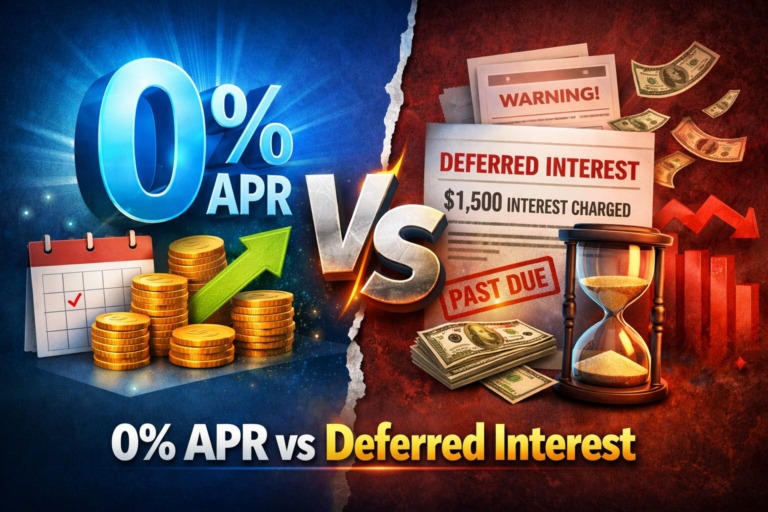
This morning, I got a call from my cousin that perfectly illustrates how confusing and costly credit card promotions can be.
She had opened a CareCredit account believing she was getting a 0% interest offer. The original balance was just over $9,000. She paid consistently and responsibly, eventually getting the balance down to about $3,000. Then, without warning, her balance jumped to nearly $7,000.
There were no new purchases and no missed payments.
What happened was deferred interest.
Because she did not pay the balance in full before the promotional period expired, all of the interest that had been quietly accruing since the original purchase date was added back to her account at once. One missed deadline erased months of progress and added thousands of dollars back to her balance overnight.
Unfortunately, this situation is far more common than people realize. Many consumers believe they are signing up for a true 0% APR promotion, when in reality they are agreeing to deferred interest financing. The difference between the two can dramatically affect both your finances and your credit score.
Understanding how these promotions actually work is critical before using them.
What Is a True 0% APR Credit Card Offer?
A true 0% APR credit card offer means that no interest is charged and no interest accrues during the promotional period. There is no hidden accumulation happening behind the scenes.
If you carry a balance beyond the promotional period, interest begins only on the remaining balance from that point forward. There is no retroactive interest added.
For example, if you start with a $9,000 balance and pay it down to $3,000 by the end of the promotion, interest applies only to the $3,000 going forward. You are not penalized for the balance you already paid.
True 0% APR offers are commonly found on balance transfer cards and some purchase-based credit cards issued by major banks. While they often require stronger credit to qualify, they are typically more transparent and consumer friendly.
What Is Deferred Interest?
Deferred interest works very differently, even though it is often marketed in similar language.
With deferred interest promotions, interest begins accruing immediately at a high rate, often between 26 percent and 32 percent, starting on the date of purchase. That interest is not shown or charged during the promotional period. It is deferred.
If the balance is paid in full before the promotion expires, the accrued interest is waived. If even one dollar remains, all of the interest from day one is added to the account at once.
This is commonly advertised as “no interest if paid in full” or “promotional financing.” CareCredit is one of the most well known examples, but many medical, dental, and retail financing accounts use the same structure.
This is not the same as a true 0% APR offer.
Why Deferred Interest Can Be So Expensive
Deferred interest promotions rely on perfect timing.
They assume consumers will:
- Fully understand the terms
- Track the exact expiration date
- Pay off the entire balance early
- Avoid processing delays or statement timing issues
Or do they? In my cousin’s situation they gave her the deferrement for 24 months but only set the monthly payments at $200. To me that is deceptive to those who don’t fully understand the credit landscape. So, when any part of the repayment plan fails, the financial consequences can be severe.
This is exactly what happened to my cousin. She believed she was doing everything right by making consistent payments. She did not realize that interest was accumulating in the background or that missing the payoff deadline by even a small amount would trigger the entire interest charge.
Deferred interest creates a false sense of security. Balances appear to decrease, but the true cost remains hidden until it is too late.
How Deferred Interest Affects Your Credit Score
The financial hit is only part of the problem. Deferred interest can also impact your credit score.
When a large interest charge is added, the reported balance increases suddenly. This can significantly raise your credit utilization ratio, which is one of the most influential factors in credit scoring.
If you are unfamiliar with how utilization works, understanding the credit utilization ratio is essential to explaining why scores often drop after deferred interest posts.
Higher utilization can lead to score declines even if payments remain on time. This is why many people experience credit score drops that feel unexplainable, even though they have not changed their payment behavior. If this sounds familiar, it may help to understand why credit scores drop even when you pay on time.
Increased balances can also impact future approvals, interest rates, and lender confidence.
CareCredit and Deferred Interest Promotions
CareCredit uses deferred interest for many of its promotional offers. While the terms are disclosed, they are often misunderstood or overlooked during the application process.
According to CareCredit’s own disclosures, interest accrues from the purchase date and is added if the balance is not paid in full before the promotional period ends. You can review this directly in their CareCredit deferred interest policy.
CareCredit can be helpful in certain situations, but it requires strict payoff discipline. It is not forgiving of missed deadlines, partial payments, or misunderstandings.
Why Credit Inquiries Matter When Opening Promotional Accounts
When applying for promotional financing, many consumers are also unsure how credit checks work.
Some applications involve hard credit checks, while others may start with prequalification. Understanding soft vs hard credit inquiries can help you avoid unnecessary damage to your credit score when exploring financing options.
Opening multiple promotional accounts without understanding how inquiries affect your report can compound the financial and credit impact if deferred interest later posts.
How to Protect Yourself From Deferred Interest Traps
Before accepting any promotional financing, ask one simple but critical question.
Is this a true 0% APR offer or deferred interest?
If the answer is deferred interest, you need a payoff plan that ensures the balance is paid in full well before the deadline. Not close. Not almost. Completely paid off.
Set calendar reminders months in advance. Pay the balance early to account for processing delays. Track the promotional balance separately from your regular statement balance.
If paying off the full balance is unrealistic, consider alternatives such as true 0% APR credit cards or structured personal loans.
What to Do If Deferred Interest Has Already Been Added
If deferred interest has already posted, review your statements carefully to confirm the promotion terms and expiration date.
You may be able to request a goodwill adjustment, especially if the balance was very close to being paid off. While not guaranteed, some creditors are willing to work with consumers who have strong payment histories.
You should also monitor your credit reports to ensure the increased balance is being reported accurately. In some cases, billing or reporting errors may be disputable.
If the interest charge has significantly impacted your credit profile, working with professional credit repair services can help you assess the damage and create a strategy for recovery.
Using Credit as a Tool, Not a Trap
True 0% APR offers give consumers flexibility. Deferred interest promotions demand perfection.
My cousin’s experience is a powerful reminder that doing most things right is not always enough when the terms are unforgiving. She did not overspend. She did not miss payments. She simply misunderstood the structure of the promotion.
That misunderstanding cost her thousands of dollars and created stress that could have been avoided with clearer information upfront.
Credit can be a useful financial tool when you understand how it works. When the fine print is ignored or misunderstood, it can quickly become a setback.
If there is one takeaway from this, it is this. Never assume a promotion is harmless just because it says no interest. Always read the terms, confirm the structure, and plan ahead.
Like my cousin, many consumers turn to a credit repair specialist in Texas when unexpected balance increases or reporting issues affect their ability to qualify for future financing.
